
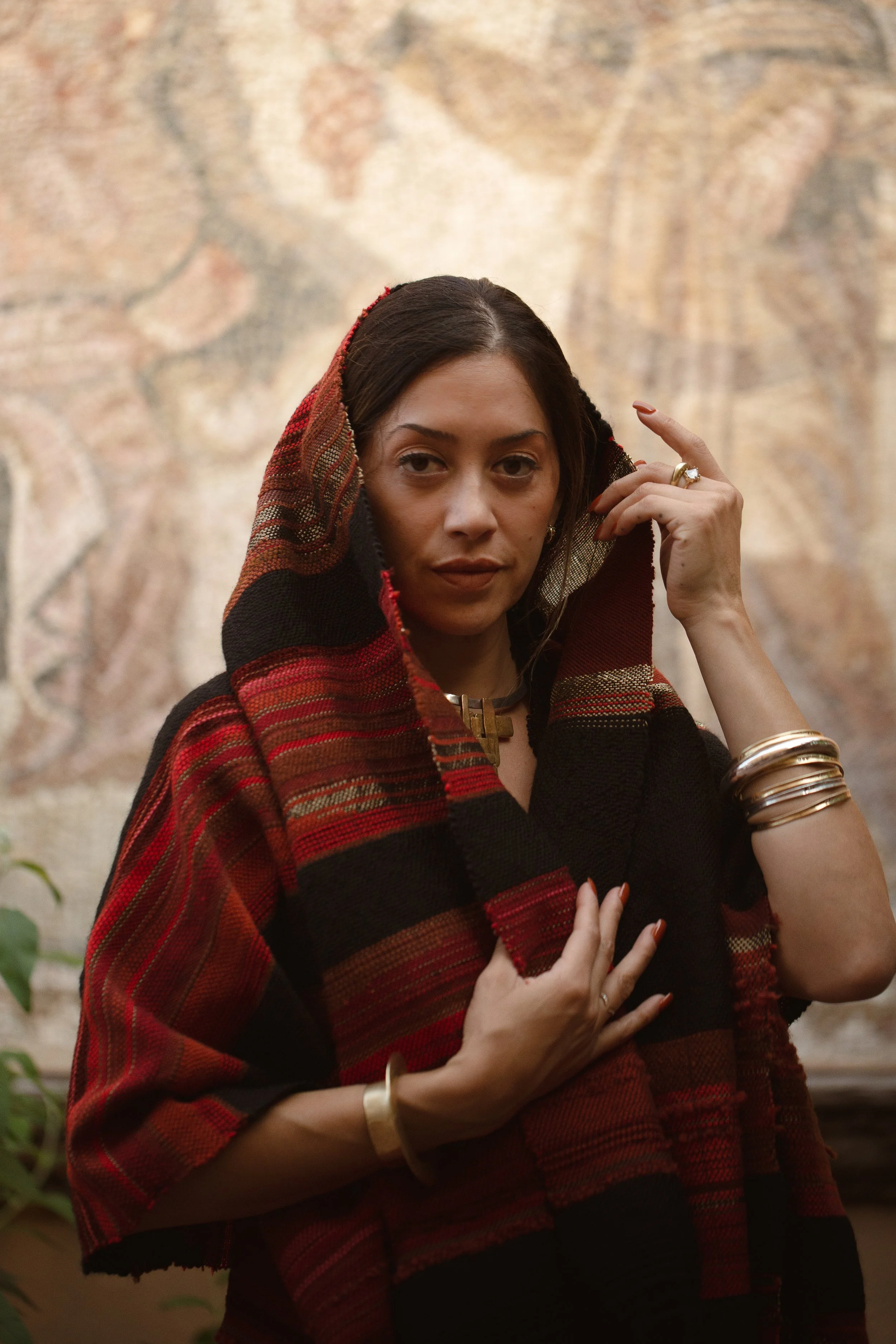
Image by Kobi Shillings
Artist Statement: My work in textiles is an expression of my desire to touch the world through the language of tactility. Cloth-making is woven into our collective human memory—an ancient practice connecting us to the natural world, to one another, to the generations who came before us and those who will after. Through my work, I hope to awaken this connection, inviting both the observer and collector to experience the inherent beauty and meaning of fiber.
Textiles are among humanity’s oldest art forms, essential to our survival and inseparable from the stories of cultures that have evolved across time and place. They hold the traces of our past while remaining part of the ever-unfolding tapestry of our present and future. I feel called to continue this ancient tradition, one that resonates with my own bloodlines, and to honor the knowledge, labor, and reverence held within the woven form.
In a world increasingly driven by speed, efficiency, and mass consumption, I am drawn to the quiet significance of the slow-made object. Through both fine art and functional textiles, I seek to restore a sense of wonder for the time, touch, and intention embodied in handmade cloth. I hope to rekindle an appreciation for the weaver’s art and for the profound, often overlooked connections between human hands, natural materials, and the Earth that sustains us.
The philosophy of Saori weaving, with its embrace of spontaneity, imperfection, and individual expression, has profoundly shaped my practice. Through a wabi-sabi sensibility, I have learned to release the need to control the outcome and instead allow the loom to guide me. This surrender has become a way of seeing: an invitation to discover beauty in the unexpected, the imperfect, and the unfinished.
My art is not separate from my life; it is an embodiment of how I choose to inhabit this world. Each thread offers an opportunity to connect—to the earth, to my ancestry, to the present moment, and to the intricate web of existence of which we are all a part.
Bio:
Rhiannon is a Santa Fe, New Mexico–based textile artist and self-taught weaver whose practice explores the fluid relationship between material, landscape, ancestry, and imperfection. Working through free-form weaving and basketry techniques, she creates handwoven textiles that honor the beauty of organic forms and the quiet poetry of the imperfect.
Rooted in the Japanese philosophy of Wabi-Sabi, Rhiannon’s practice embraces the beauty of things as they are—unrefined, impermanent, and inherently unique. Weaving becomes both a meditative process and a practice of surrender, allowing each textile to unfold in its own way rather than conforming to an ideal of perfection.
Her Mexican, Tohono O’odham, and Spanish ancestry informs her relationship to material, place, and cultural craft. These lineages serve as a living foundation for her work, which thoughtfully engages traditional textile practices through a contemporary lens. Deeply connected to the desert landscapes from which her heritage emerges, Rhiannon is attentive to the changing relationship between land, water, and material. As these landscapes are shaped by the loss of waterways and shifting ecological conditions, she continues to seek sustainable fibers that honor her roots while imagining a more conscious material future.
Every textile presented on this website is handwoven by Rhiannon herself, requiring countless hours of focused attention, intention, and devotion to craftsmanship. Her practice incorporates natural dyeing and sustainable fibers wherever possible, with each material selected for its character, integrity, and connection to the natural world. Inspired by her travels, she is especially drawn to unusual geological formations, the textures of the earth, and the distinct forms that emerge across the landscapes she encounters.
Collected internationally, her textiles are commissioned for both the wardrobe and the home, offering a tactile connection to place, material, and the handmade. Rhiannon believes that thoughtfully woven textiles are more than functional objects; they are works of art that invite a return to slower living, a deeper appreciation for natural materials, and a renewed intimacy with the everyday.